
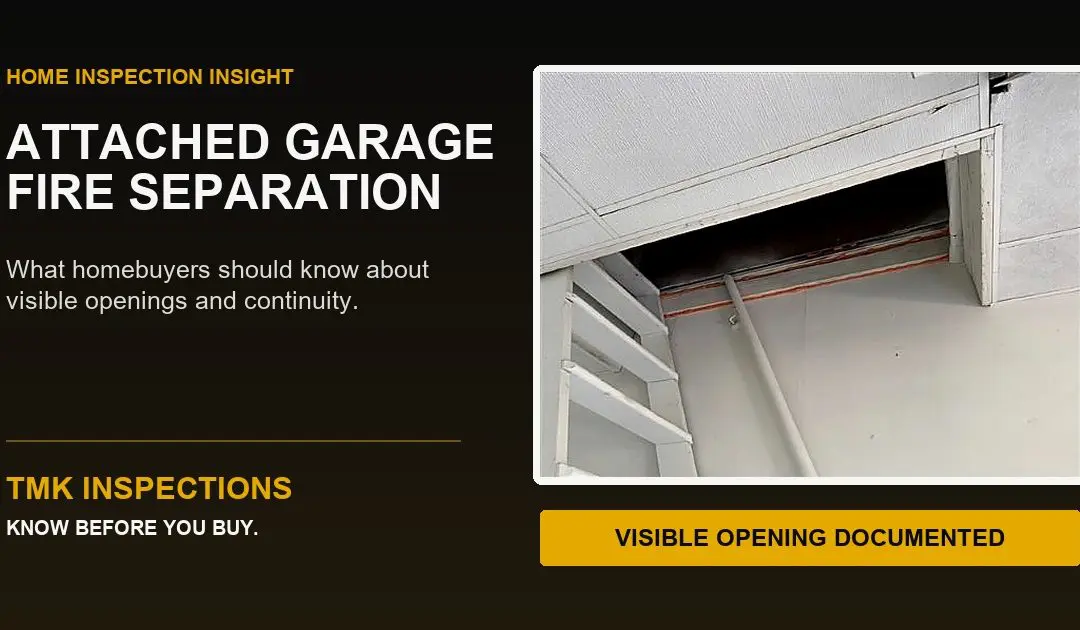
An attached garage offers convenience, but it also creates an important separation between vehicle and storage areas and the living portions of a home. During a recent Southeast Pennsylvania home inspection, we documented an open section in an attached-garage ceiling that warranted further attention.
The visible opening did not automatically tell us everything about the construction behind the ceiling. It did establish that the intended separation was incomplete at that location, so we documented the condition and recommended evaluation and proper correction by a qualified contractor.
What garage separation is intended to accomplish
Materials installed between an attached garage and the home are intended to help slow the movement of fire and combustion products. Their effectiveness depends on continuity. Missing sections, damaged materials, open chases, and unsealed penetrations can reduce that protection.
A home inspector evaluates visible and accessible conditions. The inspection does not involve dismantling finished surfaces or engineering a fire-resistance assembly. When visible openings or questionable materials are present, the responsible recommendation is further evaluation and appropriate correction—not an unsupported conclusion about concealed construction.
Conditions we commonly examine
During an attached-garage inspection, visible conditions may include:
- Missing or damaged ceiling and wall materials
- Openings around pipes, wiring, ducts, framing, or access panels
- Unfinished sections between the garage and occupied rooms
- Damage that interrupts otherwise continuous materials
- Concerns involving the door between the garage and home
- Missing garage-door safety sensors or improper door operation
Each condition should be evaluated in context. The garage’s layout, the rooms above or beside it, and the materials present all affect the appropriate recommendation.
Why this matters to buyers
Buyers naturally focus on roofing, foundations, electrical service, plumbing, and heating equipment. The garage can receive less attention, even though it may contain several systems and important safety-related components.
A clearly documented inspection finding gives the buyer useful information before closing. It also provides a reasonable starting point for discussing the condition with the seller, agent, or qualified contractor.
Clear observations—not unnecessary alarm
TMK Inspections reports what is visible, explains why it deserves attention, and identifies when specialized evaluation is appropriate. Our goal is to give buyers practical information they can use without overstating what a visual inspection can establish.
Read more practical examples in our Inspection Insights, or learn about our home inspection coverage in Chester County and Delaware County.
If you are purchasing a home in Philadelphia, the surrounding Pennsylvania communities, northern Delaware, or select South Jersey areas, request your inspection with TMK Inspections.
Recent Comments